
Bonita Lestina Old Town Hall Performance Series
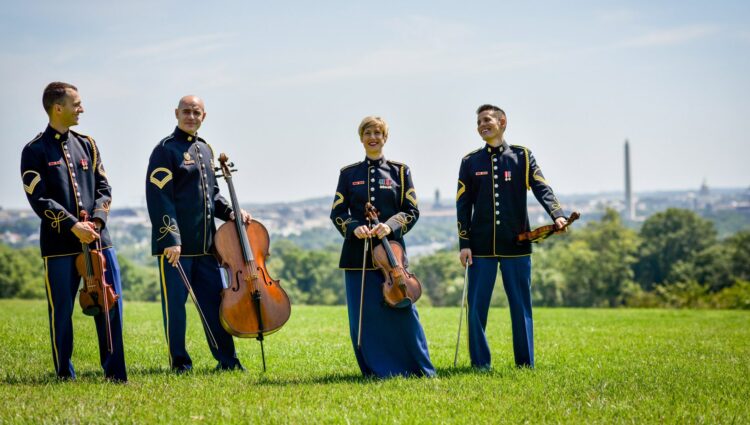
The U.S. Army String Quartet
Free and open to the public.Fri / Jan 9 / 8 pm
Location
Stacy C. Sherwood Community Center | Fairfax, VA
3740 Blenheim Blvd
Program
Johann Sebastian Bach: Contrapunctus I, IV from The Art of the Fugue, BWV 1080 arr. Richard Klemm and Carl Weymar
Dmitri Shostakovich: String Quartet No. 8 in C minor, Op. 110
Felix Mendelssohn: String Quartet No. 6 in F minor, Op. 80
Extras
Program Notes
Johann Sebastian Bach: Contrapunctus I, IV from The Art of the Fugue, BWV 1080 arr. Richard Klemm and Carl Weymar
Composed: before 1742; rev. ca. 1745 and 1748–1749
Johann Sebastian Bach's The Art of Fugue stands as one of music's most enigmatic monuments—a work left incomplete at the composer's death in 1750, its intended instrumentation unspecified, its purpose unclear.
What remains is a cathedral of counterpoint, fourteen fugues and four canons that explore every conceivable transformation of a single, austere theme. Some have posited that Bach conceived it not as music for performance but as a theoretical treatise made audible, a final meditation on the possibilities inherent in a simple musical idea. Yet for all its intellectual rigor, the work resonates with profound emotion, particularly in light of its incompleteness. The manuscript breaks off mid-phrase in what would have been the final fugue, the notes ceasing at the moment Bach introduced his own musical signature—B-A-C-H (B♭-A-C-B in German notation)—into the contrapuntal fabric, as if inscribing his name into eternity before the pen fell silent.
Tonight's performance presents two movements from this monumental cycle in Richard Klemm and Carl Weymar's arrangement for string quartet. Contrapunctus I introduces the work's germinal theme in its simplest form: four voices entering one by one, each taking up the subject and weaving it into an ever-denser tapestry.
Contrapunctus IV ventures into more complex terrain. Bach inverts the theme—turning it upside down—and sets the original and its mirror image in dialogue. The effect is both intellectually dazzling and sublimely moving, as if the subject were examining itself from every angle, discovering hidden facets with each iteration.
Though Bach never specified how The Art of Fugue should be performed, the string quartet proves an ideal medium for this music. The four unique voices allow listeners to trace each melodic line as it winds through the dialectical maze. In these arrangements, we hear Bach's abstract musical thought made flesh—not merely notes on a page, but living voices in conversation, exploring the infinite possibilities contained within a single musical idea.
Dmitri Shostakovich: String Quartet No. 8 in C minor, Op. 110
Composed: 1960
Shostakovich's String Quartet No. 8 in C minor comprises a mere twenty minutes of anxious, and rarely tender music, written in only three days in 1960 after a visit to Dresden, the German city devastated by Allied firebombing in 1945. Officially dedicated to the "Victims of Fascism and War," the quartet has sparked endless debate about its true meaning.
Shostakovich himself offered contradictory accounts: he sarcastically dismissed it as an "ideological piece of no use to anyone," yet privately described it as a deeply personal work—an epitaph reflecting on his own life and struggles. Whether commemorating wartime destruction, protesting Stalinist oppression, or mourning his own compromises with the Soviet state, the work stands as a profound expression of anguish that transcends any single interpretation. What remains undeniable is its visceral emotional power and its status as one of the most important string quartets of the twentieth century.
The quartet appears to be obsessively autobiographical. Shostakovich wrote his musical signature—DSCH (D-E♭-C-B in German notation)—wherever he could manage it, providing a genetic code that saturates the entire work. Like Bach's use of the B-A-C-H motif in final contrapunctus in The Art of Fugue, Shostakovich transforms his musical initials into a subject for contrapuntal exploration. This four-note motive opens the quartet fugally, flashes as a frightening ostinato in the violent second movement, dances macabrely in the scherzo, and becomes the subject of a heartbreaking fugue in the finale.
Looking back through Shostakovich's lifetime, the quartet quotes liberally from his earlier compositions: the First and Fifth Symphonies, the Second Piano Trio, the Cello Concerto, and his censored opera Lady Macbeth of Mtsensk. These quotations emerge like memories floating within a stream of consciousness. The fourth movement grows particularly apocalyptic, incorporating fragments of the and Russian funeral songs, punctuated by ominous knocking that has been variously interpreted as gunfire, bombing, or fate's arrival. The five movements run together without pause, tightly integrated yet violently interrupted, as if depicting a life flashing before one's eyes.
Shostakovich claimed to have shed countless tears while composing this quartet, and the music bears witness to that grief. It explores the darkest aspects of human experience—sorrow, terror, violence, shock, and a sardonic gallows humor. The work is not beautiful in any traditional sense, but it is riveting, immensely powerful, and achingly lyrical. Its emotional turmoil speaks directly to trauma that cannot be adequately expressed in words. Whether listeners recognize the intricate musical and topical references or not, the quartet delivers an unforgettable experience: a distillation of visceral emotion that functions as both personal lament and collective requiem.
Felix Mendelssohn: String Quartet No. 6 in F minor, Op. 80
Composed: 1847
Born into a family of considerable means and intellectual support, Felix Mendelssohn fully realized the possibilities afforded to him. He composed, painted, wrote, and performed as a pianist and organist from an early age. His supportive father, a wealthy banker, bought a grand estate in Berlin which became an artistic hub for the musical city. Acclaimed artists, literary figures and affluent colleagues attended the Mendelssohn’s salon concerts to hear Felix perform his own music, often comparing the young prodigy to Mozart.
Felix’s older sister Fanny, just like Mozart’s older sister, Nannerl, was a child prodigy in her own right. Though the Mozart siblings eventually grew apart, Felix and Fanny grew only closer and more mutually devoted after childhood. They dedicated many compositions to each other, championed each other’s work, and corresponded lovingly and prolifically.
Fanny suffered an untimely and deadly stroke in May of 1847. So taken with grief, upon hearing the news, Felix immediately suffered a stroke of his own. His wife had insisted he take leave of his performance schedule to recover in Switzerland where he spent his days in nature, painting the Swiss landscape and composing the Quartet in F minor, op. 80. Soon after returning to Germany, his days saturated with grief, he suffered another stroke and died at the age of 38.
Felix Mendelssohn’s music is lauded for its technical brilliance, though sometimes criticized for its emotional restraint. The F minor quartet repudiates any such criticism.
“It would be difficult to cite any piece of music which so completely impresses the listener with a sensation of gloomy foreboding, of anguish of mind, and of the most poetic melancholy, as does this masterly and eloquent composition,” wrote a Mendelssohn’s lifelong friend Julius Benedict.
The first movement opens with violent, anxious tremolos. Explosive outbursts give way to sobbing lyrical moments. The movement ends in a Presto of unremitting anguish. Audiences past and present expect Mendelssohn’s scherzos to be light and quixotic after his famous scherzo from A Midsummer Night’s Dream. The second movement’s scherzo clouds all daylight; its syncopations jab, and its themes broil.
The slow movement is a tender, but nonetheless tear-soaked song without words, evoking the intimate piano works the siblings wrote and often dedicated to each other. Closely interwoven melodic lines mirror their tight kinship. Drama and anger return in the fourth movement. The first violin launches into frenzied triplets, one last desperate grasp at freedom from the gloom, driving headlong into tragic conclusion.
Get Social
- Sign up for our Email list
Upcoming Events

Music from the Hearts of America
Smithsonian National Museum of American History | Washington, DC
Thursday / Jul 9 / 12 pm
Army Strings
Honoring the legacy of American music since 1776, join The U.S. Army Strings for a special performance that inspires and unites. Enjoy this opportunity to experience this group in public for this All-American program. Free and open to the public.
Music from the Hearts of America
Smithsonian National Museum of American History | Washington, DC
Thursday / Jul 9 / 1:30 pm
Army Strings
Honoring the legacy of American music since 1776, join The U.S. Army Strings for a special performance that inspires and unites. Enjoy this opportunity to experience this group in public for this All-American program. Free and open to the public.
Stories, Suites, and Sonatas
Sherwood Regional Library | Alexandria, VA
Sunday / Jul 12 / 3 pm
Chamber Players
Enjoy a FREE chamber music concert by members of "Pershing's Own" to include woodwinds, brass, chorus, and strings. Featuring a retelling of Ferdinand the Bull, mixed ensembles, and a salute to America's 250th. All are welcome!
Music from the Hearts of America
Smithsonian National Museum of American History | Washington, DC
Thursday / Jul 16 / 12 pm
Army Strings
Honoring the legacy of our country's music, join The U.S. Army Strings Jazz Trio for an All-American program that inspires and unites. Free and open to the public.
Music from the Hearts of America
Smithsonian National Museum of American History | Washington, DC
Thursday / Jul 16 / 1:30 pm
Army Strings
Honoring the legacy of our country's music, join The U.S. Army Strings Jazz Trio for an All-American program that inspires and unites. Free and open to the public.

Echoes of Eternity
Rachel M. Schlesinger Concert Hall and Arts Center | Alexandria, VA
Friday / Jul 17 / 7:30 pm
Concert Band
Explore "Echoes of Eternity," a tapestry of sound from Fanfare Ritmico to O Magnum Mysterium. Featuring guest conductor Dr. Donald McKinney (IU Jacobs School of Music). A celebration of musical legacy and spirit. Free and open to the public.

Rock the Block! Summer Concert
Old Town Square | Fairfax, VA
Friday / Jul 24 / 6:30 pm
Downrange
Free and open to the public.

Summer Capitol Concert
U.S. Capitol | Washington, DC
Friday / Jul 24 / 7:30 pm
Brass Quintet
Free and open to the public. Check back for weather cancellations.

Stories of a Nation
Harris Pavilion | Manassas, VA
Saturday / Jul 25 / 7 pm
Concert Band
Celebrating America 250, The U.S. Army Band presents a musical tribute to the people, ideals, and stories that shaped our nation. Featuring Casey at the Bat, Hamilton, Hercules, and more. Free and open to the public.
Friends of Patterson Park Concert Series
Patterson Park | Baltimore. MD
Sunday / Jul 26 / 6 pm
Downrange
Free and open to the public.
Summer Capitol Concert
U.S. Capitol | Washington, DC
Friday / Jul 31 / 7 pm
Country Roads
Free and open to the public. Check back for weather cancellations.
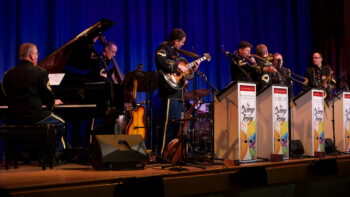
Vienna Town Green Concert Series
Vienna Town Green | Vienna, VA
Friday / Jul 31 / 7:30 pm
Swamp Romp
Free and open to the public.
Summer Capitol Concert
U.S. Capitol | Washington, DC
Friday / Aug 7 / 7 pm
Downrange
Free and open to the public. Check back for weather cancellations.
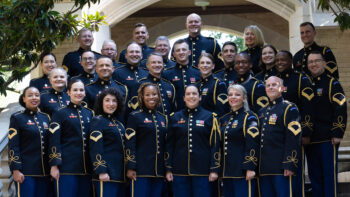
70 Years of Singing Service
National Presbyterian Church | Washington, DC
Saturday / Aug 8 / 4 pm
Army Chorus
Join The U.S. Army Chorus as it celebrates its service to the nation through music. Free and open to the public.
Summer Capitol Concert
U.S. Capitol | Washington, DC
Friday / Aug 14 / 7 pm
Concert Band
Free and open to the public. Check back for weather cancellations.
Hillsboro Community Concert
Old Stone School | Hillsboro, VA
Friday / Aug 28 / 6 pm
Swamp Romp
Free and open to the public.
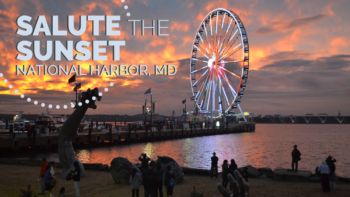
Salute the Sunset at National Harbor
National Harbor Main Stage | Oxon Hill, MD
Saturday / Sep 5 / 7 pm
Concert Band
Free and open to the public.
Salute the Sunset at National Harbor
National Harbor Main Stage | Oxon Hill, MD
Saturday / Sep 12 / 7 pm
Downrange
Free and open to the public.
Concert Odyssey Presents
St. John's Episcopal Church | Ellicott City, MD
Sunday / Sep 20 / 4 pm
Army Chorus
Free and open to the public.
Chamber Music Concert
Women in Military Service for America (WIMSA) | Arlington, VA
Sunday / Sep 27 / 2 pm
Chamber Players
Free and open to the public.

A Salute to Veterans
Hylton Performing Arts Center | Manassas, VA
Friday / Nov 6 / 7:30 pm
Concert Band
The U.S. Army Concert Band and Army Chorus concert is free and open to the public; tickets are available through the Hylton Center for the Performing Arts box office starting Tuesday, August 4 at 10 AM. Walk-ins welcome at 15 minutes prior to start.